Understanding a Split Receptacle
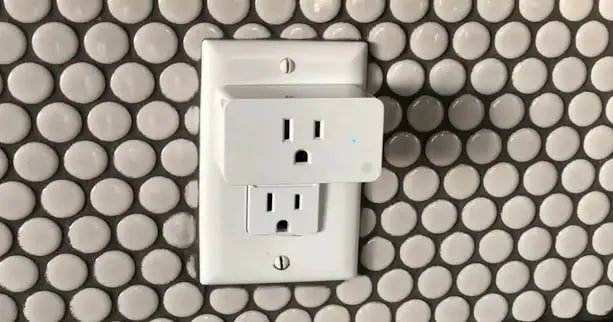
Many switched outlets are actually split receptacles, meaning each half of the outlet performs a different job.
Typically:
- The upper receptacle is controlled by the wall switch.
- The lower receptacle provides continuous power.
This allows you to leave a lamp plugged into the switched portion while still using the other half for devices that require constant electricity.
For example:
| Switched Outlet | Always-On Outlet |
|---|---|
| Floor lamp | Phone charger |
| Table lamp | Alarm clock |
| Holiday decorations | Wi-Fi router |
| Accent lighting | Vacuum cleaner |
This practical design eliminates the need to unplug lamps whenever you need power for another appliance.
How to Tell If Your Outlet Is Switch-Controlled
Testing an upside-down outlet only takes a few minutes.
- Plug a lamp into the top receptacle.
- Turn nearby wall switches on and off.
- Watch whether the lamp responds.
- Repeat the test using the lower receptacle.
If one half turns on and off while the other remains powered, you’ve discovered a split receptacle.
Sometimes the controlling switch is located near a room entrance rather than beside the outlet itself, so be sure to test every switch in the room.
Is an Upside-Down Outlet Safer?
Another reason some electricians prefer installing outlets with the grounding slot on top involves safety.
Imagine a partially unplugged cord with exposed metal prongs. If a metal object such as a coin, key, or paper clip accidentally falls between the plug and outlet, having the ground prong on top means the object is more likely to contact the grounding conductor first rather than the energized prongs.
While this situation is uncommon, some professionals believe this orientation slightly reduces the chance of an electrical short.
Both ground-up and ground-down installations are generally acceptable under electrical codes unless a local regulation specifies otherwise.
Common Myths About Upside-Down Outlets
Many homeowners have misconceptions about flipped outlets.
Myth: The electrician installed it incorrectly.
Reality: It may have been intentionally oriented to identify a switched outlet.
Myth: Upside-down outlets are dangerous.
Reality: They are generally just as safe as standard outlets when installed correctly.
Myth: Every upside-down outlet is connected to a wall switch.
Reality: While many are, some may simply reflect the installer’s personal preference or local building practices.