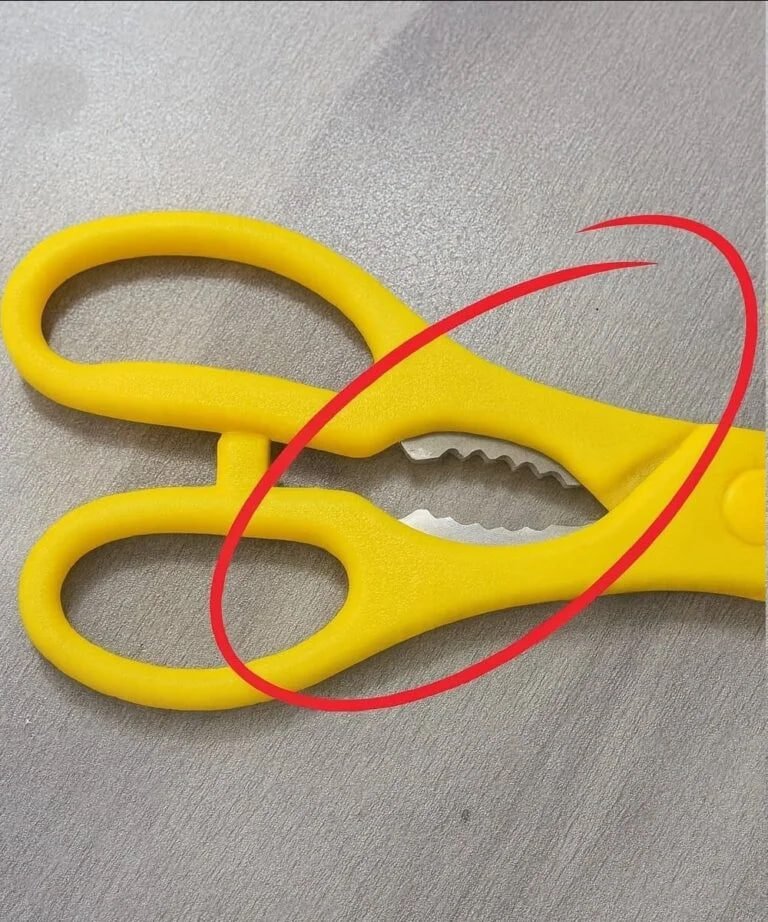
Have you ever noticed the jagged, tooth-like part hidden between the handles of your kitchen shears, just behind your fingers? You may have wondered what it’s for. If you’ve never used this little feature, you’re not alone. Many people think it’s just decorative or unnecessary.
But in reality, that serrated part is a surprisingly practical built-in tool. It’s not a bug or a gimmick—it’s an ingenious design element that can make life in the kitchen a lot easier. Let’s take a look at what it does, how to use it, and why you should pay more for it.
Pay attention to it the next time you pick up a pair of scissors.
First things first: What is it?
This ridged area is often called a can opener, nutcracker, or bone grabber, depending on the brand. But simply put, it’s a gripping device.
You’ll find it where the handles curve inward. Sometimes it’s made of metal, sometimes reinforced plastic. When you close the scissors slightly, the grooves interlock, creating a powerful grip that prevents objects from slipping.
Think of it as your kitchen shears’ “silent companion” – always ready to give you an extra grip when you need it.
Tip #1: Open stubborn jars and bottles.
We’ve all been there – standing in the kitchen, struggling with a jar lid that won’t turn. Maybe you’ve tried knocking it or wrapping it in a towel. Nothing works.
This is where the built-in gripper shines:
Close the scissors just enough so that the teeth meet.
Place the jar lid between the ridges.
Hold the scissors in one hand and the jar in the other.
Twist.
The grooves help you grip the lid, and the leverage distributes the pressure evenly. Suddenly, a stuck lid won’t seem so impossible anymore. This also works with small bottle caps – like soda or sauce bottles.
This feature can be a real lifesaver for anyone with limited hand strength or arthritis.
Tip #2: Crack nuts without a nutcracker
Don’t have a nutcracker at home? No problem. This serrated handle will help you crack walnuts, pecans, hazelnuts and more.
Place the nut in the grooved slot.
Gently press the handles until the shell cracks.
Twist the nut and repeat until the shell comes off.
The key is patience – don’t squeeze too hard. The goal is to crack the shell, not crush the nut inside. It may not be as fine as a real nutcracker, but it will get the job done when needed.
Tip #3: Cut Small Poultry Bones
If your scissors are heavy-duty (like poultry shears), the bristles can help you grab and cut small chicken bones like wings, thighs, or drumsticks.