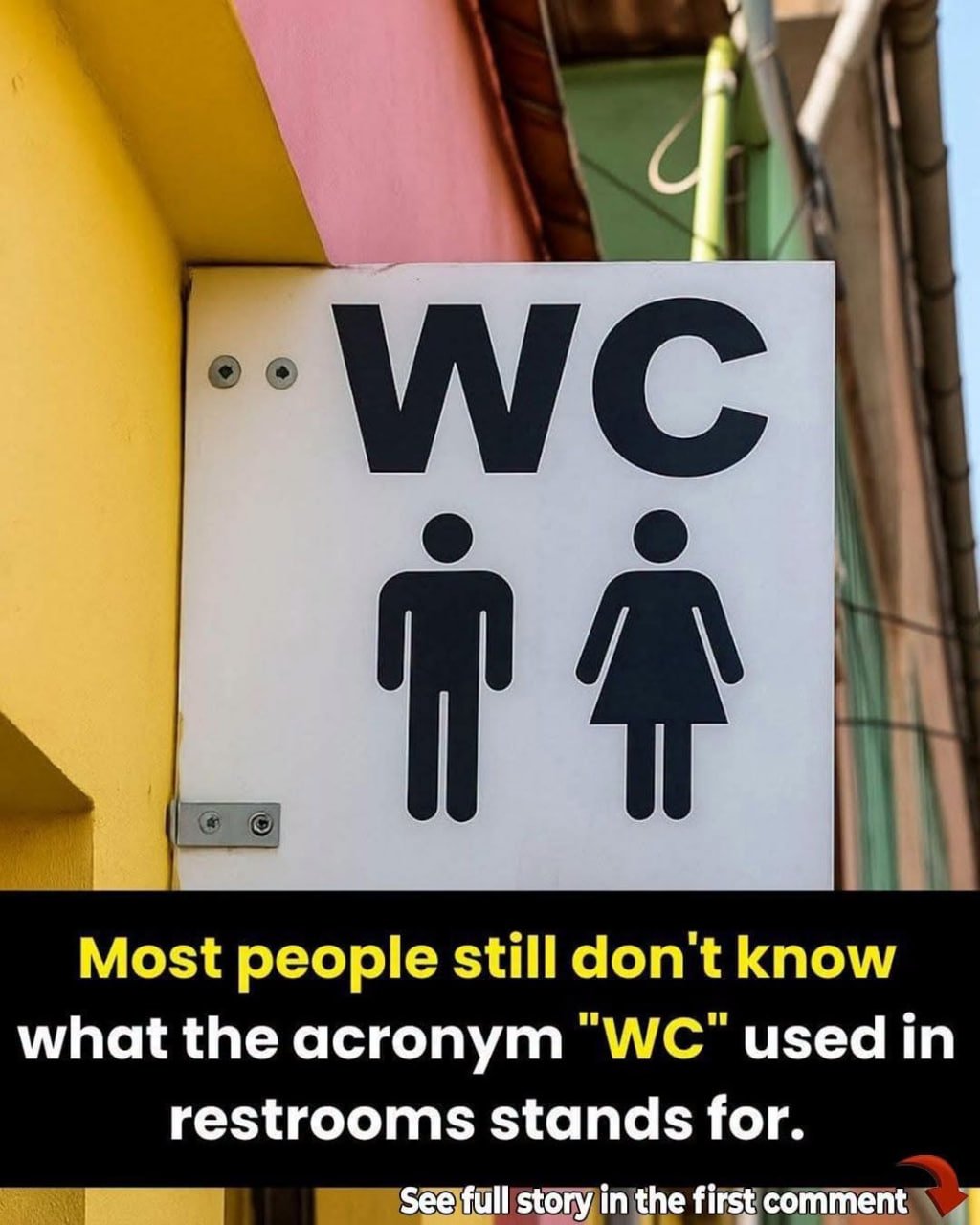
Have you ever traveled abroad, walked through an airport, train station, hotel, or shopping center, and spotted a sign labeled simply “WC”?
For many people, those two letters are instantly recognizable. Yet for countless others, the abbreviation remains one of travel’s most common little mysteries.
You may know where the sign leads, but have you ever stopped to wonder what “WC” actually stands for?
Surprisingly, many adults are only now discovering the answer.
The abbreviation appears throughout Europe, the United Kingdom, and countless international destinations. Despite its widespread use, the meaning behind it often goes unexplained.
The answer is simple:
WC stands for Water Closet.
While the term might sound old-fashioned today, it has a fascinating history that stretches back to the early days of indoor plumbing and modern sanitation.
Let’s explore how this curious abbreviation originated, why it remains so common around the world, and what it reveals about the evolution of bathrooms as we know them.
What Does WC Mean?
The letters WC stand for Water Closet.
The phrase originated during the nineteenth century when indoor plumbing began transforming homes and public buildings.
Breaking down the term is surprisingly straightforward:
- Water refers to the running water used for flushing.
- Closet refers to a small enclosed room.
Put together, a water closet was literally a small private room containing a flush toilet.
Unlike modern bathrooms, these rooms often contained only a toilet and nothing else.
At the time, this distinction was important because bathing facilities and toilet facilities were frequently located in separate spaces.
Today, many people assume bathrooms have always looked the way they do now, but history tells a very different story.
Before Indoor Plumbing Changed Everything
For most of human history, there was no such thing as a modern bathroom.
People relied on:
- Outhouses
- Chamber pots
- Privies
- Public latrines
- Communal facilities
Bathing was also a completely separate activity.
Many homes contained dedicated bathing rooms where water was manually carried and heated before use.
Meanwhile, toilets were located elsewhere.
When indoor plumbing emerged during the Victorian era, architects faced a challenge.
Homes already had bathing rooms.
Where should the new flush toilets go?
The solution was simple.
Install them inside small private rooms connected directly to the new water supply.
Those rooms became known as water closets.
The name stuck.