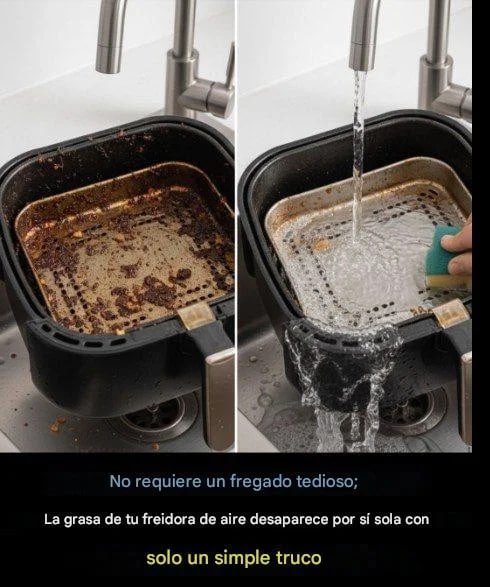
Air fryers are popular in many kitchens because they produce crispy results with little or no oil. But after several uses, a common problem arises: the accumulation of grease and food residue in the cooking chamber and basket. These deposits are permanent and often force users to resort to complex scrubbing or strong cleaning agents. This is where a simple cleaning method comes to the rescue, which can significantly reduce the hassle.
Air fryers work by circulating hot air and cooking food in the same way as a convection oven. During this process, fat particles are released from the food and deposited on the interior surfaces. Especially with high-fat foods, a sticky layer can form over time that is difficult to remove.
The often-talked-about "simple trick" is not based on magic, but on physical and chemical principles: fat dissolves more easily when heated and exposed to moisture. This combination can be used to make cleaning easier without the need for harsh scrubbing.
1. The Basic Idea of Self-Cleaning
The trick is that grease softens when heated and comes off the surfaces. If more steam is produced, it can soften the grease particles and loosen them from the walls of the air fryer.
So instead of scrubbing dry, you create a moist cleaning environment that loosens the residue, so to speak. This makes it much easier to remove with a soft cloth.
2. Easy cleaning trick step by step
First, turn off the air fryer completely and let it cool down a bit so that it is warm but no longer hot.
Next, a small, heat-resistant bowl of water is placed in the basket. Some people also add a dash of mild dishwashing liquid or a little lemon juice to loosen the grease.
The appliance is then operated on medium heat for a few minutes. The heat produces water vapor that is distributed inside the appliance. This steam will adhere to the grease deposits and begin to dissolve them.
Allow the fryer to cool down for a while after the process. After that, any loose residue can be easily removed with a soft cloth or sponge without any vigorous rubbing.
Continued on next page
3. Why this trick works
The effect is based on three factors:
Heat
The grease becomes more liquid at higher temperatures and loses its adhesion to surfaces.
Steam
The water vapor penetrates the thin layers and softens the scale.
Cleaning agents (optional)
A mild dishwashing liquid will reduce the surface tension and help emulsify the grease.
The combination of these factors replaces mechanical force with a physical solution.
4. Which parties benefit the most