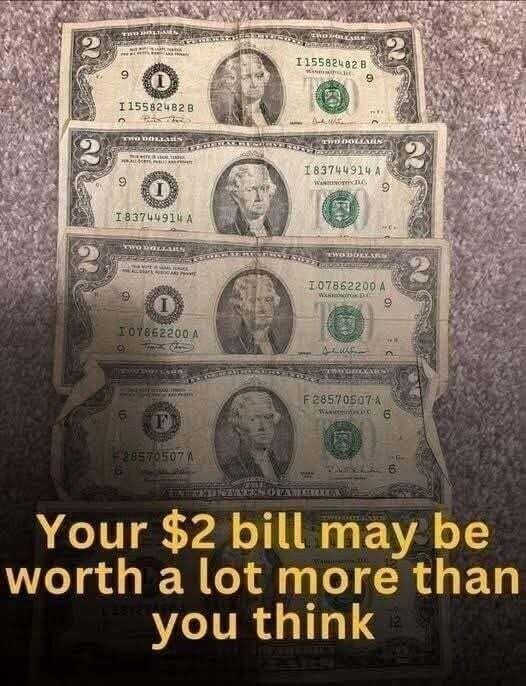
Many people overlook the humble $2 bill. It often sits forgotten in a drawer, tucked inside an old wallet, or stored away in a collection of miscellaneous cash. Because it appears so rarely in everyday transactions, many assume it must be either extremely valuable or completely obsolete.
The truth lies somewhere in between.
While most $2 bills are worth exactly two dollars, some can be worth significantly more to collectors. Depending on factors such as age, condition, rarity, printing errors, and serial numbers, certain notes have sold for hundreds or even thousands of dollars.
Before you spend that unusual bill you found, it may be worth taking a closer look.
A Brief History of the $2 Bill
The United States first introduced the $2 bill in 1862 during the Civil War. At the time, the government was looking for ways to improve the nation’s currency system and reduce reliance on coins.
The earliest versions featured Alexander Hamilton, the nation’s first Secretary of the Treasury. Later designs replaced Hamilton with Thomas Jefferson, whose portrait remains on the front of the bill today.
Over the decades, the appearance of the $2 bill changed several times. Different seal colors, signatures, printing methods, and artwork variations have created numerous collectible editions.
Although many people believe the $2 bill is no longer produced, the U.S. Treasury continues to print them in limited quantities. They remain legal tender and can still be obtained through many banks.
Why Are $2 Bills So Rare?
One reason $2 bills attract attention is their scarcity in daily circulation.
Unlike $1, $5, $10, or $20 bills, the $2 denomination never became widely popular with consumers or businesses. Many people viewed it as unusual and chose to save it rather than spend it.
This created an interesting cycle:
- People received a $2 bill.
- They considered it special.
- They saved it.
- Fewer bills remained in circulation.
As a result, many Americans go years without seeing one, even though millions remain in existence.
What Makes a $2 Bill Valuable?
Several factors determine whether a $2 bill is worth more than its face value.
Age
Generally speaking, older bills are more desirable to collectors. Notes printed in the late 1800s and early 1900s can command substantial premiums.
Condition
Condition plays a major role in value.
Collectors use terms such as:
- Poor
- Fair
- Fine
- Very Fine
- Extremely Fine
- Uncirculated
A crisp bill with no folds, tears, stains, or writing will usually be worth significantly more than a heavily used note.
Seal Color
Many older $2 bills feature colored Treasury seals.
Collectors often seek:
- Red seals
- Brown seals
- Blue seals
Red-seal notes from the 1928 and 1953 series are particularly popular among beginning collectors.
Star Notes
A star symbol at the end of a serial number indicates a replacement note printed to replace one that was damaged during production.
Because fewer star notes are printed, they are generally more collectible than standard notes.
Printing Errors
Mistakes made during the printing process can dramatically increase value.
Examples include:
- Misaligned printing
- Ink errors
- Fold-over errors
- Missing seals
- Double prints
Rare error notes often attract strong interest from collectors.